On the 5th of September it was the 250th birth anniversary of the German romanticist painter Caspar David Friedrich. Germany is awash with his celebrations – Hamburg, Dresden and Berlin all have and have had exhibitions of this best-known Romanticist painter. I am writing this from a hamlet in Saxony, in the background testimonial walking tours of Friedrich’s mountains, whose profile I can see from my window at night. It’s a new moon and the sky that frames the mountains is empty without this familiar visual and philosophical co-ordinate. This absence resonates a parallel anniversary: Twenty years ago this month NASA published the first images of the earth as seen from another planet – Mars. These images continued a series initiated by the iconic Earthrise, 1968, (Image 1) the first recorded image of the view of over here (the earth) from over there (the moon). These NASA images are renowned for their philosophical resonance, material evidence of the decentring of the human that has been threaded through our ontological world since Copernicus discovered that the universe did not, in fact, revolve around us. Earthrise and its many successors, both one shot analogue and composite digital through Blue Marble (Images 5 & 7) up to the contemporary view from Mars, continue to tilt the theoretical axis. The importance of these very different representational technologies, one poetic, the other ‘technological’, is that both these cosmic enterprises reveal how people determine their world and how that world works for them: they are epistemological practices, echoing how each makes claims to the places and spaces that we inhabit, and the philosophical, social and political fault lines embedded therein.
Shadowing European colonisation of the earth the colonisation of space has been historically irresistible to aspirants to mastery. These determinations resonate in Saxony as much today as in the Saxony of 250 years ago that defined itself in opposition to Napolean’s invasion. Saxony is at the threshold of a culture. It’s a place where Europeans, the ancient ones of modernism, face East– whas congealed into a sort of blankness, a monocultural hum, a solid consistency: the way Dresden has been cleaned of the dust of history so that have been blanked out: what’s left is thrown into sharp relief, silhouetted like Fredrich’s mountains against the night sky. Compare with Berlin, a city that hums with Walter Benjamin’s piles of debris from the past. But Saxony’s homogeneity blunts very sharp edges; the growing momentum of the Alternative fur Deutschland in the region; or the original gangster communist speaking at the foot of the DDR’s Kultutrepalast on a sunny Wednesday afternoon; the Schopstal villager flying the flags for both Russia and the German Empire. And today in the virtual background echoes resonate from the UK, the NASA images from warlike Mars mesh with the stark anti-immigrant violence that emerged on the streets organised by the English Defence League.
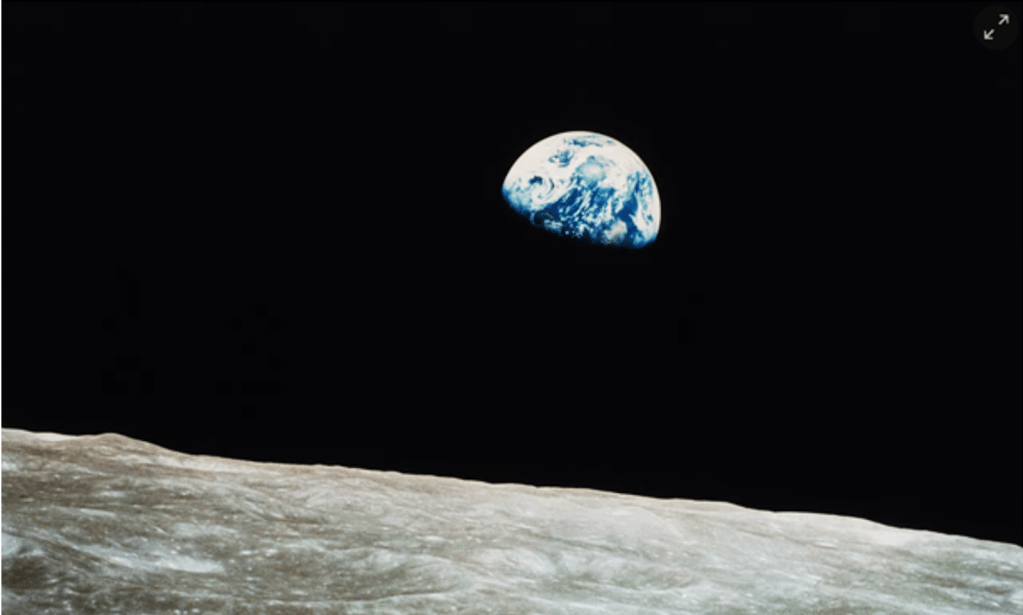
Image 1. Earthrise (Nasa Image AS8-14-2383 Apollo 8 Dec 1968)
Born in in North Germany near the Baltic coast Friedrich settled in the southeast in Dresden, in part to be close to the sublime landscapes of Sächsische Schweiz, Germany’s mountainous and rocky national park. Friedrich spent most of his life ‘at home’: staying local was part appetite and partly enforced – Napoleons’ excursions east of the Elbe constrained, and traumatised, Friedrich. His philosophical precursor, Immanuel Kant is renowned for barely leaving the east Prussian town of Konigsberg in which he was born. This homely-ness, an attachment to a locale that is common to both thinkers implies the purposeful construction of a place from which to view the world: Pursuing the precise ontological location of the thinking subject in relation to their environment, Kant imagined the world from his study. Similarly, Friedrich’s paintings are visions that modulate the view from ‘over here’ to ‘over yonder’, the ontological inside to the ontic outside.
Parallel to shows at the Albertinum in Dresden and the Kunst Halle in Hamburg[3], The Alte Nationalgalerie in Berlin hosts Caspar David Friedrich, Infinite Landscapes[4], a comprehensive gatheringof Friedrich’s visual investigations into this metaphysical transaction.The exhibition is replete with familiar images that resonate with the sublime, the idealism of the Enlightenment. Although the most reproduced of Frierich’s subject- formed-by-the-sublime paintings – Wanderer above the Sea of Fog (1818) – is absent, all the of work here takes us through the ontological paces of subject location. On the one hand Chalk Cliffs on Rugen 1818 (Image 2) visualises the oceanic expanse through the – our – frame of the cliffs, the figure on the right on solid and secure ground taking ownership of all that is viewed; on the other in Morning Mist in the Mountains 1808 (Image 3) we are inside the object ‘nature’. An object that remains hard to grasp or determine other than as affect.
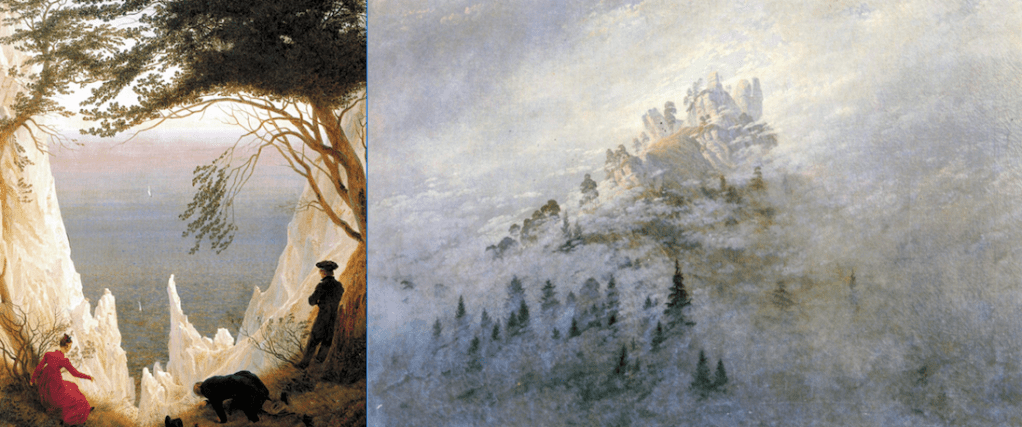
2. Chalk Cliffs on Rügen (1818) 3. Morning Mist in the Mountains (1808)
This thread comes into sharp focus through the inclusion of originals and the copies and versions of other well-known paintings, and the typology used, and the visual stand-ins employed in their construction. These appear like avatars- in the grey zone between Morning Mist and Chalk Cliff the subject is what is at stake – in Riesengebirge Landscape with Rising Fog 1819 (Image 4) a dead tree stands as a figure, tethering the space. So, it stands in for us – as we project this landscape we simultaneously project ourselves in it: but an alienated us, busy with the labour of conception, simultaneously host of, and stranger in.
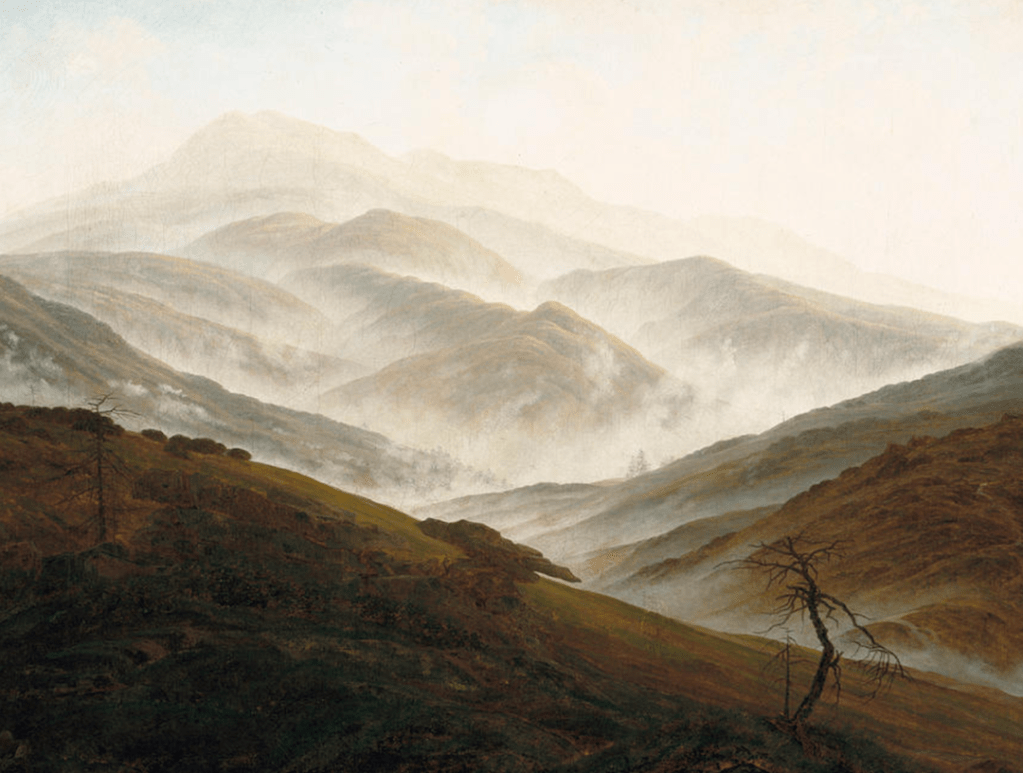
4. Riesengebirge Landscape with Rising Fog 1819
Discrete modulations between light, type, composition echo the epistemological revelations of technological development in NASA’s image production: they are representations of us, how we locate ourselves in respect to the universe. Friedrich preferred to transmit what he saw in himself rather than what he saw in front of him: ‘in a sense what I wish to depict and the way in which I seek to do so remains a riddle even to me’. In the copies and series of paintings you can see how Friedrich as a thinker strives to exceed the determining limits of his gaze:‘ If you were to meditate and ponder from morning to evening, from evening all the way to the declining midnight, you will never be able to conceive of, to comprehend, the unfathomable Beyond’,[5] This echoes Kant’s terms, the noumenal world that in itself is withdrawn to us, what exceeds representation, the unpresentable, the incomputable.
Amongst the series paintings is Freidrich’s well-known image of Two Men contemplating the Moon, first painted in 1819 (Image 6) and re-configured at least another three times. Three of these are on display in Berlin. In the same way when NASA’s photographs are read as a group, they parse the human subject through its possible cosmic locations. The Moon paintings trace shifts in perspective, forcing the Romanticist subject position through the ontological gears, triangulating on the Friedrich data sets of woman, man, nature and god into a hierarchy of metaphysical/spiritual, technological and existential. They present as distant companions to NASA’s images, modulating between reflections and negatives. Although each painting presents the exact same composition, the same narrative scenario, the small shifts in content, focus and light change the point of view radically.
Topping the hierarchy of visualisations of the world is NASA’s iconic 1972 image Blue Marble. It completes the Copernican revolution, representing a planet that is individual, isolated, seemingly awake to its limits, a fragile and unique object exposed to dynamic and sublime forces: it benefits from both an exhilaration of scale, speed and intensity as well as an attendant apprehension and perspective. On the one hand this view of earth from space is optimistic, modulating what ‘space philosopher’ Frank White coined as the ‘Overview Effect’, a collection of positive mental experiences reported by astro- and cosmonauts returning from space as a result of a ‘Copernicus perspective’[6], getting an intimation of the inherent isolation and singularity of the planet. On the other it speaks as much of limits as possibilities. This is because of what we can’t see, the dark side of the globe: even as the representation takes possession of the earth it requires effort and imagination to complete its spherical reality and it is barely possible to grasp it as a unified entity in one view, and this is vertiginous. It’s what Kant called the mathematical sublime, and it’s a question of scale.
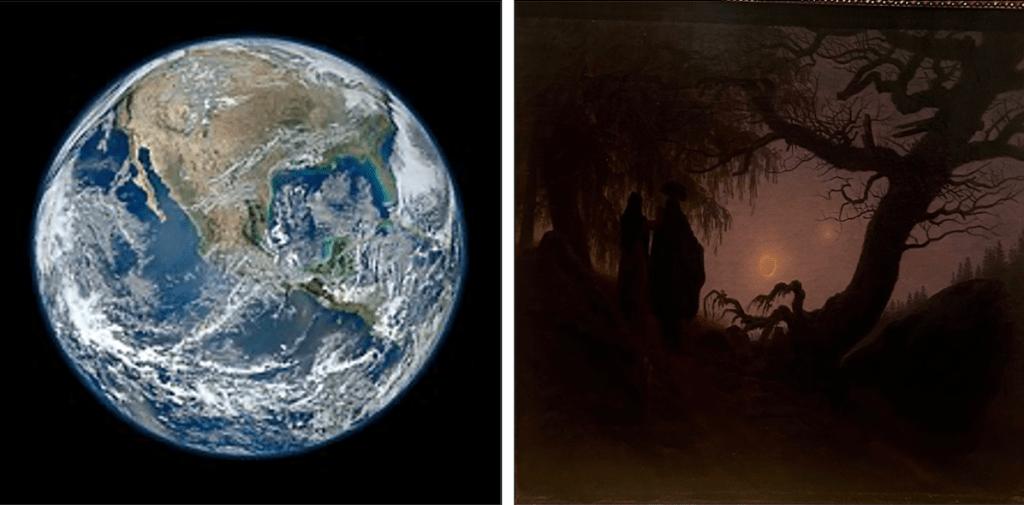
5. Blue Marble (NASA image AS17-148-22727 Apollo 17 Dec 1972)
6. Two Men Contemplating the Moon 1819/1820
Although Friedrich’s Moon 1819 reverses the gaze, the transaction is the same. At once it’s an image of the human contemplating the possible, and the earthy tones and dim lighting are reassuring. Next the whole scene is cast in darkness, the blank silhouettes of two men against the bare light of a new moon. Although some features of the foreground are dimly identifiable the spaces in between over here and over there must be filled in. Like in Blue Marble (1972) the world’s knowledge of itself and whatever exceeds it remains fundamentally withdrawn.
Taken together they form the ur-Romanticist view, that the worlding of the earth is a correlation of the material and the imaginative. Kant’s Transcendental Aesthetic, proposed an approach to the problems of perception in which space and time are not objective, but provide ways in which the observers thinking organizes and structures the sensory world. Because we can’t hold it in our mind as a unified object it remains withdrawn to us, presenting an earth without the ‘us’, as the singular planetary. But it’s inherent loneliness, the vulnerability, triggers the boomerang of the sublime, the imperative of the universal citizen of the enlightenment to prevail, to explore and bring within their system.
On the face of it as a philosophical event the version of Blue Marble taken forty years later by NASA in 2012 tells the same metaphysical story, but it doesn’t. As opposed to the analogue snap of 1972, this image is a digital composite of multiple images and as such is a construction, a fiction. Software is asked to perform like architecture in the way it organises people in space and time. It figures a technical object, in this case a montage rendering the earth as Globe – ontologically smooth, generalised, flattened, deprived of the ideological perspective implied in the 1972 version. As opposed to the poetic revelation of the earth as a vulnerable planet this version determines it as single bounded system, a constructed technical object of unlimited computational scale: it’s a prosthetic.
Similarly In Friedrich’s Man and Woman 1824(Image 8)the light has shifted from the 1819 version; the figures and foreground are dim and indistinct, details flattened, while the outside of ‘over yonder’ seems brighter. There is an infinite distance between the homogeneity of a world that is imaginatively constructed by its inhabitants and the unconstrained limitless outside. The implication is that we are inside this render, and our experience is simply idealised, a projection. Channelling ur-German idealism Friedrich urges: ‘Close your bodily eye so that you can see your image with your mental eye. Then bring out the light that which you have seen in the darkness, so that it now has in impact on others, from the outside towards the inside[7]’. Like Tommy Robinson/Yaxley-Lennon’s on the micro, on the meta this view is a situated one, figuring earth-as-world as a central bounded system which will inevitably fill the empty space that surrounds it – any protagonist goes from being a citizen of the earth to a citizen of the universe as a neo-imperialist imperative. Not only philosophical events, both these representations, as models of earth NASA’s renders are deeply political objects, asserting a claim of control and technological mastery at a universal scale. The way both images are made and the perspective they create reveal the complexities of worlding through to the planetary – in NASA’s case optimistically creating an incommensurably large technological network of representations that perform the possibility of all potential worlds.
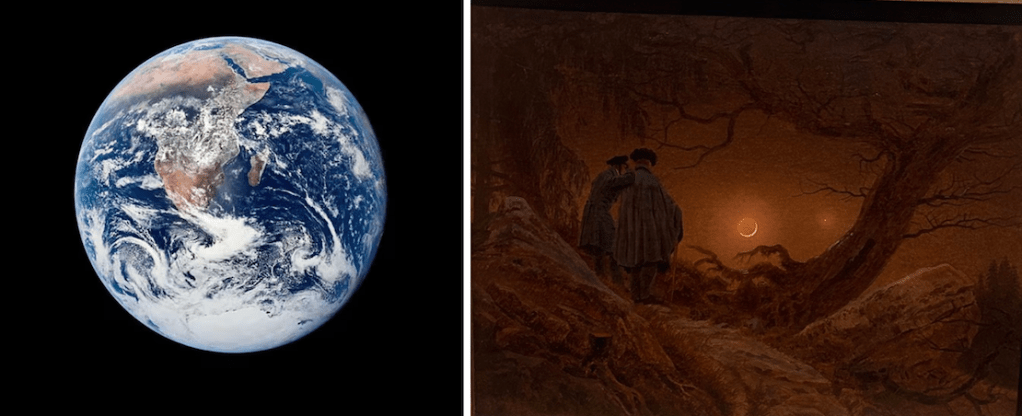
7. Blue Marble 2012. Digital composite image
8. Man and a Woman Contemplating the Moon 1824
In 1830 Friedrich painted the last known version of this composition, and again the scene shifts (Image 9). Like the 1824 version there is a clear distinction between over here and over there, but what’s here is not shrouded in shadow. As opposed to the anonymity of the man and woman (standing in as archetypes) we can trace the features of these men’s faces, the clothes they wear, some intimation of conversation: they are filled out, in relief, and their world is taking form. Although reversed, there seems to be the same kind of distinction, perspective between the world and its place in the universe as we can see in NASA’s Earthrise, 1968, which was the first ever image of the earth taken from elsewhere. Like the astronaut who took this photograph from the moon, the men stand at the border zone between the worldly and the planetary, at the threshold of their world and that which exceeds it, the pivot point between their phenomenological ideation and their faith. This is being alone in the world: ‘space philosophy’ describes how the Fighter pilots flying at the highest altitudes, at the sharp edge, the hostile horizon, who experience the ‘break off phenomenon’where they identify very closely with their craft and disconnect from everything else. This brings on an ‘ultra view effect’[8] that creates a sense of our ‘limitations of our knowledge, incomprehension, and self-diminution’. This is the loneliest[9] place – Earthrise is also known as the image of everyone in the universe except for astronaut William Anders, who took the photo on a handheld camera. If this is a representation of a threshold, then this is also the place that echoes through nineteenth century Saxony in Friedrich’s paintings. The post-Copernican view that is exercised in Friedrich’s paintings is congealed through NASA’s image production, unfolds in contemporary thought in Gayatri Spivak’s mobilisation of the figure of ‘planetarity’ in Death of a Discipline: the globe as an abstract space that is “in our computers and allowing us to control it.” It creates the political opportunities that difference affords – the concept of the planet, which is “in the species of alterity, belonging to another system; yet we inhabit it, on loan.[10]” Like the border controls in the twenty-first century UK for that matter, Friedrich’s paintings represent our exposed place – the created territory that both produces strangers and strangers of ourselves. A place which asks us where we and how we are in respect to others, the complexities of ownership of the planet, the spaces that we call home, and who has the right to extend hospitality to whom.
Herschel Adair
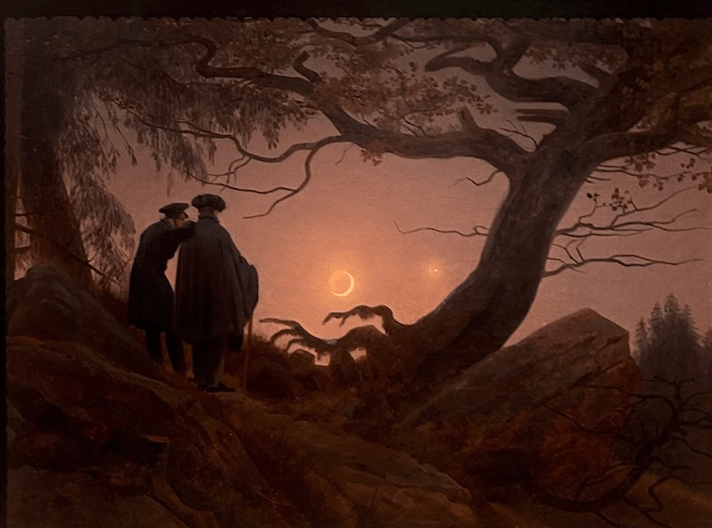
9. Two Men contemplating the Moon 1830
[1] https://www.nasa.gov/history/20-years-ago-first-image-of-earth-from-mars-and-other-postcards-of-home/
[2] https://albertinum.skd.museum/en/ausstellungen/caspar-david-friedrich-where-it-all-started/
[3] https://www.hamburger-kunsthalle.de/en/caspar-david-friedrich
[4] https://www.smb.museum/en/exhibitions/detail/caspar-david-friedrich/
[5] Hilmar Frank. Caspar David Friedrich: Infinite Landscapes Exhibition Catalogue, London: Prestel, 2024, pp.69-70
[6] David, Leonard (August 2, 2022). “Space philosopher Frank White on ‘The Overview Effect’ and humanity’s connection with Earth”. Space.com. Archived from the original on August 9, 2022.
[7] Fredrick Berwick and Jürgen Klein The Romantic Imagination: Literature and Art in England and Germany Amsterdam, Rodopi, 1996)
[8] Weibel, Deana (August 13, 2020). “The Overview Effect and the Ultraview Effect: How Extreme Experiences in/of Outer Space Influence Religious Beliefs in Astronauts”. Religions. 11 (8): 418.
[10] Spivak, Gayatri Chakravorty, Death of a Discipline, New York 2003.
 Ancelania

Leave a comment