It’s was no surprise when Teslas sales were damaged by Musk’s political life so in March President Trump assembled three models on the White House lawn. Pointing at Musk and the Cybertruck: ‘who else but this guy would design this and everybody on the road is looking at it‘. It’s a legible performance that sites Musk and his avatars, Tesla, Space -X, even the inculpable X Ash A-12, as charms on Trumps bracelet, trinkets to invoke a great, glittery MAGA future.
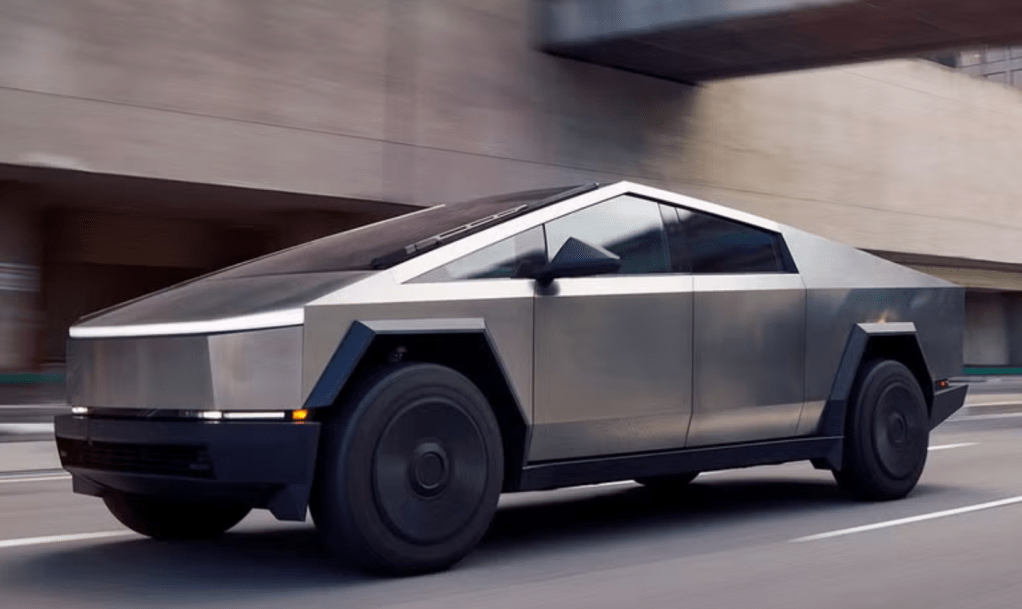
Tesla Cybertruck 2023
Musk’s response – we want the future to look like the future – discloses the Cybertruck’s assignment. Musk’s design for Cybertruck was based on the Spinner cars from the Blade Runner movies, which in turn echoed the concept cars of the eighties like the Citroen Karin that flexed a kind of calculator aesthetic. A style that looks exactly like cars of the future, but as if seen from the past – it’s all casing with no content except for the shadow of technology, like an old computer that articulates nothing. An entirely speculative object empty of meaning other than these referents, Cybertruck has no direct lineage of its own, no development or design arc – is a bald-faced simulacra, a copy without an original that motors out of a fictional past into a staged future that is itself retro, opaque. It speaks more of a fabulated techtopia where climate change is just a texture of an accelerated planet. Dismantling a tomorrow that is distinct and radically different from the present, MAGA reanimates an old pre modern pre-future that is ‘a dead wall or a thick mist hiding all objects from view’ (William Hazlitt).
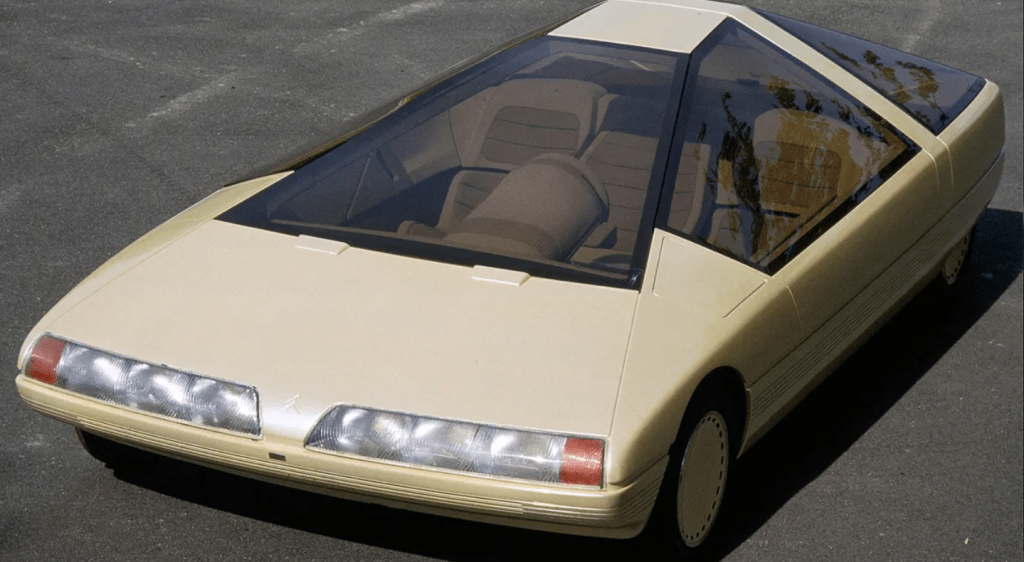
Citroen Karin 1980
If Musk’s design is textual, eerily shadowing Putin’s political technologist Vladislav Surkov’s fictional sorties, it follows to credit him with intent. Straight out of Frederick Jameson’s postmodern schematic, generationally appropriate and in itself a retro theoretical move, it’s as if MAGA has animated Guy Debord’s playbook on the spectacle as it mobilises a nostalgia mode that recycles a discourse about the stability of the past. Forecasting has been substituted with the hypothetical ‘ifs’ of Ukraine, Gaza, institutional waste, air traffic control etc that would never have happened if Trump had been President is what scholars of the discipline of ‘future studies’ refer to as recasting: a double movement of fictioning that looks to the past to imagine how the present, and by extension the future, might look different by ‘imagining’ roads not taken, buses missed.
Thus Cybertruck vibrates with the retro-injection of change into the fabric of a recursive future. Its emptiness is noisily articulate, it resonates with MAGA allohistory. Like Musk’s reanimation of a survivalist colony on Mars it alerts us: something is weirdly off here if they think this is going to work. Now part of the vernacular, Trumps first term testified to the weird. It was like watching simulacra delaminate – a glitching matrix – from the aching emptiness of the inauguration to Guiliani’s dripping hair dye at the Four Seasons (Landscaping Inc.) press conference, concluding with a comic minotaur rampaging through the Capitol.
As Musk/Trump cut and paste realities, when ‘the links of the signifying chain snap, then we have schizophrenia in the form of a rubble of distinct and unrelated signifiers’ (Jameson) – and almost literally when encoding rather than naming your son – the ironies compound as the of a pluralizing of the past and the recasting of the future trails a plume of lost opportunities: electric vehicles could have gone mainstream at any point, that the dominance of the internal combustion engine was not inevitable? Political wagers explode into the now – foreseeable futures, normalised trajectories of technology are replaced with the possibility of radical but unforeseeable futures. Ironically the resulting psychological shocks actually stifle rather than generate change. The effect mimics that described by Raymond Williams in his novel Border Country, an account of the decline of primary industries like coal mining in mid-century Wales, foreshadowing that of contemporary America: ‘you could talk about creating the future, but in practice, look, people ran for shelter, maneuvered for personal convenience, accepted the facts of existing power. To see this happening was a deep loss of faith, a slow and shocking cancellation of the future’
If America’s future’s been cancelled it’s been replaced by a pageant, a parade of images that fulfil Debord’s prophecy that the culture has ‘become the final form of commodity reification a world transformed into sheer images of itself and for pseudo-events and spectacles’
 Ancelania
Leave a comment