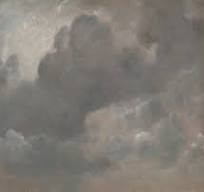
Cloud study, 1822, John Constable.
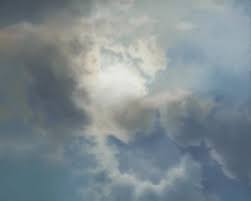
Wolkenstudie, 1978, Gerhard Richter.
Undercover taxonomist John Constable annotated his studies of clouds. On the reverse of each oil sketch – and there were well over a hundred of them- he recorded the date, the time, the direction and force of the wind, the approximate position of the sun. “Noon. Gentle wind from the NW.” “Sept. 11th. 10 o’clock Morning looking South-East.” (1) The annotations were not incidental. They were, in some sense, the point. The painting was not an interpretation of weather but a record of it ; and the record, Constable insisted, had to be accountable to the thing it recorded.
Gerhard Richter’s cloud paintings do something else entirely. Large-format, sourced from photographs, and then deliberately blurred, the image dragged across itself in long horizontal strokes until the cloud isrecognisable but the photograph it came from is not. The clouds are clearly clouds, but they are clouds as memory, as concept, as the trace of an idea of clouds. Richter has spoken about the blur as representing the limits of perception – we never access the thing itself, and that painting honest to this fact must show the smear between perceiver and world. (2)
These two works do not merely illustrate opposing aesthetic styles. They stage, in the most condensed form available to visual art, one of the oldest and most consequential disputes in European philosophy- a dispute I have spent these past months exploring from the inside.
Now in Berlin, I’m usually in Edinburgh. The Scottish philosophical tradition is, by temperament and lineage, empiricist. Hume was born in Edinburgh, and the particular cast of his scepticism – rigorous, deflationary, suspicious of what cannot be grounded in sensation or demonstrated by argument – has left a durable mark on the culture of philosophical instruction in Scottish universities. In tutorials, we were rewarded for identifying where an argument went wrong, for finding the counterexample, for what my supervisor once called “not letting things float.” Precision is a virtue, the well-formed argument is an achievement, and to understand something is to be able to say exactly what it is and what it is not. Constable fits this tradition perfectly. He disliked what he called “the dark pictures” of the Old Masters – those vast, murky canvases where weather was narrative rather than descriptive. His clouds are not symbols of anything. They are clouds. To understand a cloud, you look at a cloud – carefully, repeatedly, in different conditions. The idea of clouds comes after the fact, if it comes at all. He called the practice “skying,” and in a letter to his friend John Fisher in 1821 described the sky as “the chief organ of sentiment” in landscape – not a symbol imposed on nature, but nature’s own most expressive fact. (3) And this epistemology has enormous pedagogical consequences. If what matters is getting the observation right, then philosophy becomes a discipline of attention and precision. You learn to read closely, argue carefully, to spot the flaw in the chain.
German idealism begins by questioning the very terms of that picture. Kant’s decisive move, the Copernican revolution , was to argue that theconditions of experience are not features of the world encountered by the mind, but structures the mind brings to experience in order to make it intelligible at all. Space, time, causation are not properties we read off from reality but forms we impose on it. The thing in itself, the Ding an sich, is not merely difficult to know, it is, in principle, unknowable. What we have access to is always already interpreted, structured, mediated. For Hegel, this is not a defeat but the beginning of a different kind of inquiry. If consciousness does not passively receive the world but actively constitutes it, then the history of thought becomes the history of those constitutive structures transforming themselves – Spirit coming to know itself through the very forms of its own activity. Philosophy ceases to be a discipline of better observation and becomes something closer to a discipline of self-recognition. The question is not only: what is the case? It is: what kind of mind finds this to be the case, and what does that reveal about the mind doing the finding?
The concept that crystallises this difference, for me, is Bildung; most often translated as “cultivation” or “formation,” though neither quite captures it. To study the Phenomenology is not to acquire information about Hegel’s views, but it is to subject oneself to a process in which the categories through which one understood the world before the encounter are tested, strained, and in some cases abandoned. You emerge, if it goes well, not with better answers but with different questions. The seminar is not a space for solving problems but a space for being changed by them.
Coming to Berlin as an exchange student – arriving from one tradition into another, with the additional difficulty of still learning the German language, meant experiencing this contrast not as an intellectual proposition but as something more like a physical fact. What I had been trained to do well: construct tight arguments, expose hidden assumptions, resist the pull of eloquent vagueness, felt not merely insufficient but somehow beside the point. What I came to understand, slowly, is that the empiricist tradition is very good at establishing when a claim is wrong, but less reliable as a guide to what makes a claim worth making in the first place. Hume can tell you, with remarkable precision, the limits of what can be known. He is not especially helpful on the question of what you should do at those limits, or who you should become in response to them. The idealist tradition, for all its genuine excesses of abstraction, insists that this is exactly the question philosophy must ask. To stop at the edge of the verifiable and call it rigour is, from the idealist’s view, to mistake the boundary of a method for the boundary of philosophy itself. There are questions that survive the empiricist audit – about what to do at the limits of knowledge, about who one becomes in confronting them – and declining to ask them is not restraint. It is a narrowing.
This is what separates Constable and Richter, finally, and why the comparison is more than a aesthetic contrast. Constable’s practice is predicated on the belief that scrupulous attention can close the gap between image and world. Richter accepts that the gap cannot be closed, and makes this acceptance the content of the work. The blur is not an admission of failure. The blur is not Richter failing to be Constable. It is Richter saying that Constable’s project – the belief that looking hard enough can close the gap between image and world – is impossible. He claims that the smear between perceiver and perceived was never a distortion to be corrected, but a constitutive feature of experience itself.
Having studied in both registers, in two countries, in two languages that carry their philosophical inheritances differently, I find I am no longer able to treat the choice between them as a matter of institutional habit or national style. The empiricist insistence on precision and accountability, and the idealist insistence on self-examination and transformation, are not competing answers to the same question. They are the question, approached from different ends. Constable and Richter are both looking at clouds, the difference is in what each believes looking can achieve.
Lily May Hardie.
1 Constable undertook several campaigns of cloud painting on Hampstead Heath between 1820 and 1823, “usually noting the date, time and weather conditions” on the reverse of each study. One surviving example, held at the Yale Center for British Art, is inscribed: “Sept[ber] 13th one o’clock. Slight wind at North West, which became tempestuous in the afternoon, with Rain all the night following.” Yale Center for British Art, Paul Mellon Collection, B1981.25.156
2 “I can make no statement about reality,” he said in a 1972 interview, “clearer than my own relationship to reality; and this has a great deal to do with imprecision, uncertainty, transience, incompleteness.” Richter, in conversation with Rolf Schön, 1972; collected in Gerhard Richter: Text. Writings, Interviews and Letters 1961–2007 (Thames & Hudson, 2009).
3 Constable to John Fisher, October 1821; cited in National Gallery of Victoria catalogue entry for Clouds (Felton Bequest, 1938). The full passage reads: “It will be difficult to name a class of landscape in which the sky is not the keynote, the standard of scale, and the chief organ ofsentiment … The sky is the source of light in Nature, and governs everything.”
References:
Constable, John. Letter to John Fisher, October 1821. Quoted in National Gallery of Victoria. “Clouds.” Catalogue entry, Felton Bequest, 1938. National Gallery of Victoria, Melbourne.
Constable, John. Cloud Study. September 1822. Oil on paper laid on board. Yale Center for British Art, Paul Mellon Collection, B1981.25.156.
Richter, Gerhard. Gerhard Richter: Text. Writings, Interviews and Letters 1961–2007. London: Thames & Hudson, 2009.


Leave a Reply